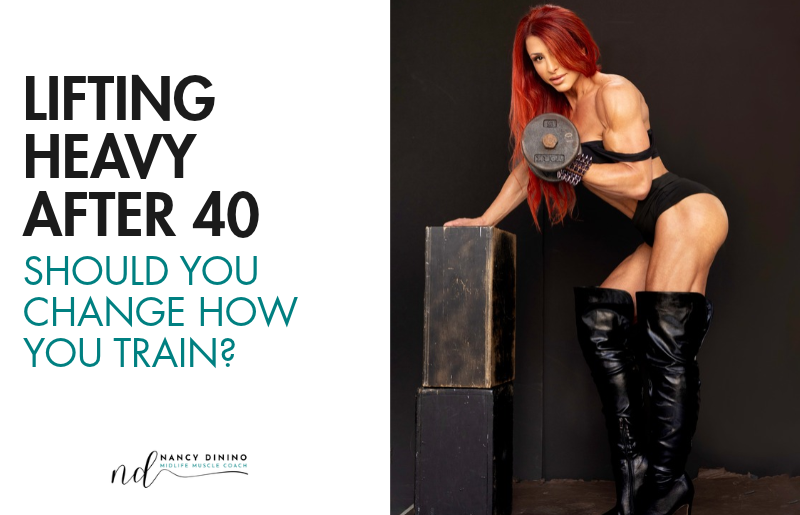
Lifting Heavy After 40: Should You Change How You Train?
I still remember the first time someone told me I needed to be more careful because I was over 40.
I was in the middle of a heavy deadlift session, feeling pretty damn strong, when someone decided to offer some unsolicited advice about what I was doing to my joints.
I smiled, finished my set, and went right back to doing what I was doing.
There’s this idea that once we hit 40, we need to start “taking it easy”. Maybe lighten the weights a little. Stop pushing so hard. Be more careful because our “bodies aren’t what they used to be”.
I’ve spent YEARS in the gym, including pro competing, and I can tell you for a FACT that turning 40 doesn’t mean you need to trade your heavy weights for a pair of pink dumbbells.
But there ARE some things worth talking about, especially when perimenopause enters the picture.
Your Joints Aren’t Falling Apart
One of the biggest arguments I hear against lifting heavy as we get older is that it’s “terrible for our joints”.
Except that’s not how strength training works.
When you’re lifting with good form, progressing at a reasonable pace, and giving your body time to recover, resistance training can actually help support the muscles and connective tissues around your joints.
There’s research backing this up, a study highlighted by the University of Exeter found that resistance training can improve physical function in women going through menopause.
Of course, if you’ve got an existing injury or something genuinely hurts, that’s a different conversation. I’m never going to tell someone to push through an injury just to prove they can lift heavy.
But being over 40, on its own? That’s not an injury.
Perimenopause Is Where Things Get Interesting
Now, THIS is where I see a lot of women getting frustrated.
You’ve been working out for years. You know your way around a gym. You’ve figured out what works for your body, and you’ve been consistent.
Then somewhere in your 40s, things start changing.
Maybe you’re not recovering as quickly. Your sleep is suddenly garbage. You’re dealing with more fatigue, and the workouts you used to crush feel harder than they should.
And let’s not even get started on the changes in body composition.
It’s frustrating, especially when you’ve spent years putting in the work.
Hormonal changes during perimenopause can affect muscle, bone health, sleep, and recovery. That doesn’t mean you need to stop challenging yourself in the gym. In fact, maintaining muscle and strength becomes increasingly important during this stage of life.
So, what it DOES mean is that you might need to rethink how you’re approaching your routine.
Maybe you need another recovery day, or your training volume needs adjusting, or you’re just so used to pushing through exhaustion that you haven’t stopped to consider whether it’s actually helping you anymore.
You can still train hard, just pay attention to how your body is responding.
Sources:
https://pmc.ncbi.nlm.nih.gov/articles/PMC9864448/
https://www.healthcentral.com/condition/menopause/strength-training-during-menopause
Yes, You Can Still Build Muscle After 40
Can we PLEASE retire the idea that women stop building muscle once they reach a certain age?
Because I hear this one far too often.
Progressive overload still works after 40. Your muscles still respond to being challenged, and you can absolutely continue getting stronger.
Research from the University of New South Wales found that older women benefit significantly from resistance training, including improvements in muscle size and strength.
Now, will your progress look exactly like it did when you were 25? Maybe not.
You might find that you need more time between challenging sessions, or that your old training split doesn’t fit your life quite as well anymore.
That’s fine.
I’ve always believed that training should challenge you, but there’s a difference between working hard and running yourself into the ground.
And if you’ve been lifting for decades, you probably already know that adding more weight to the bar isn’t the only way to make progress.
So, Should You Change How You Train After 40?
Maybe! But probably not in the way you’ve been told.
If you’re feeling great, recovering well, and continuing to make progress, there’s no reason to overhaul your entire routine just because you’ve celebrated another birthday.
On the other hand, if you’re constantly exhausted, your strength is dropping, or you’re struggling to recover between sessions, it’s worth looking at what’s going on.
And please, stop assuming that every change you’re experiencing means you’re getting old. Sometimes your training needs adjusting. Sometimes your nutrition isn’t supporting what you’re asking your body to do. And sometimes perimenopause is throwing a wrench into a routine that worked beautifully for the last 20 years.
I’ve worked with women who know how to train. They don’t need someone explaining what a dumbbell is or telling them to try harder.
They need someone who understands what happens when the body they’ve spent years building starts responding differently.
That’s exactly the kind of work I love doing.
If you’re over 40, you’ve been lifting for years, and you’re frustrated because what used to work isn’t getting you the same results, I’d love to help you figure out your next chapter in the gym.