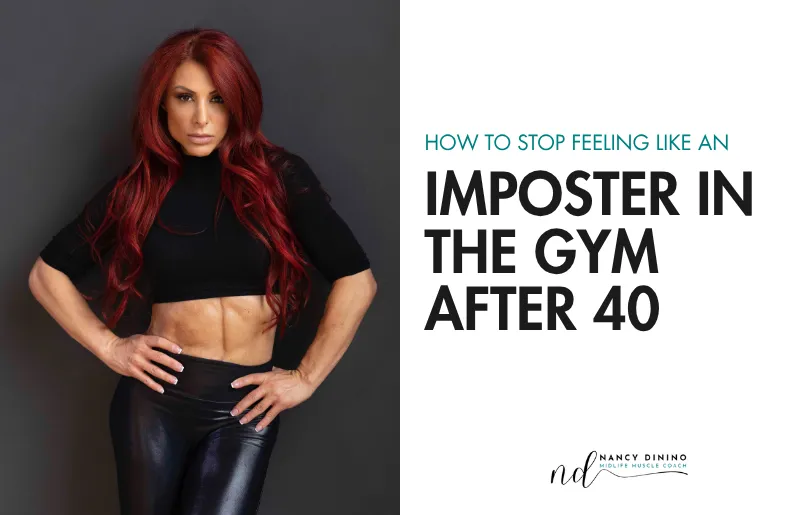
How to Stop Feeling Like an Imposter in the Gym After 40
When was the last time you put yourself first? Not just in theory, not as something you planned to do next week, but actually, genuinely first? If you're struggling to answer that question, you're not alone. And if you're a woman in your 40s or 50s who used to be incredibly fit, who used to love the gym, who used to feel strong and confident in her body, and now feels like that version of herself is somehow out of reach, this is for you.
Making Yourself the Number One Priority in Midlife
There is a particular kind of exhaustion that comes from decades of putting everyone else first. Your career. Your kids. Your partner. Your friends. And somewhere in the middle of all of that, you quietly moved yourself to the bottom of the list. Not because you didn't matter, but because life kept asking more of you and you kept saying yes.
But here's what happens when you consistently deprioritize yourself: your health suffers, your energy suffers, and over time your sense of self suffers too. Research published in the Journal of Health Psychology found that self-care practices are directly associated with better physical health outcomes, reduced stress, and improved emotional wellbeing, particularly in midlife women. Self-prioritization isn't selfish. It's survival.
In midlife, your body is going through significant hormonal changes that demand more intentional care, not less. Estrogen declines, cortisol becomes harder to regulate, muscle mass starts to decrease at a rate of roughly three to five percent per decade after 30 according to research from the American Journal of Clinical Nutrition. These aren't things that resolve themselves if you ignore them. They require active, consistent attention.
Putting yourself first in midlife means scheduling your workouts like the non-negotiable appointments they are. It means prioritizing sleep. It means fueling your body with intention. It means saying no to the things that drain you and yes to the things that restore you. And it starts with deciding, firmly and without apology, that you matter enough to show up for.
Your Health Deserves to Cost as Much as a Louis Vuitton Bag
Let's talk about money for a second. Because I've heard it too many times. "I can't afford a trainer." "The program is too expensive." "I'll invest in my health when things settle down." And yet those same women will spend hundreds or even thousands on a handbag, a vacation, a kitchen renovation, without a second thought.
I'm not judging the handbag. What I'm challenging is the belief that your health is somehow less worthy of that investment.
According to the CDC, chronic diseases driven largely by lifestyle factors account for roughly 90 percent of the United States' annual healthcare spending of 4.1 trillion dollars. The cost of not investing in your health now is exponentially greater than the cost of investing in it today. Every dollar you put into your fitness, your nutrition, your hormonal health, and your mental wellbeing is a dollar that pays dividends for decades.
A Louis Vuitton bag holds its value. But nothing holds its value quite like a strong, healthy, capable body that carries you through every experience life has to offer. Your health isn't a luxury purchase. It's the foundation everything else is built on.
When you reframe the cost of investing in your health not as an expense but as a return on investment, everything shifts. The question stops being "can I afford this?" and starts being "can I afford not to?"
Five Ways to Shed Imposter Syndrome in Your Fitness Journey After 50
This one is for the woman who used to be an athlete. Who used to train hard, look strong, and feel completely at home in the gym. And who now walks in and feels like a fraud. Like she doesn't belong there anymore. Like everyone can see that she's not the person she used to be.
Fitness imposter syndrome is real, and it hits especially hard for women who had a strong athletic identity earlier in life. The body changes. The performance changes. And it can feel like you've lost something fundamental about who you are. Here's how to start taking it back.
Separate who you are from what you can currently do
Your identity as a strong, capable woman is not contingent on lifting the same weights you lifted at 30. The woman who shows up today, even if she's starting from a different place, is still a woman who shows up. That is the identity that matters. Research in the Journal of Aging and Physical Activity shows that exercise self-efficacy, meaning your belief in your ability to exercise successfully, is one of the strongest predictors of long-term fitness adherence. Build that belief by celebrating what you can do, not grieving what you used to do.
Redefine what progress looks like
Progress after 50 doesn't always look like the scale moving or hitting a personal record. Progress looks like better sleep. Less inflammation. More energy. Improved bone density. A stronger immune system. A 2022 study published in the British Journal of Sports Medicine found that resistance training in women over 50 significantly improves not just muscle mass but also cognitive function, mood, and quality of life. Track the things that actually matter.
Stop comparing your chapter five to someone else's chapter one
Social media is a highlight reel. The woman you're comparing yourself to may have a completely different hormonal profile, a different history, a different program. Your only competition is the woman you were yesterday. Focus on your own data, your own progress, and your own story.
Give yourself permission to start where you are
One of the most paralyzing things about imposter syndrome is the feeling that you have to earn your place before you can show up. You don't. You show up first, and you earn everything else in the process. The gym doesn't belong to people who already have it figured out. It belongs to everyone willing to walk through the door.
Find a community that sees you
Isolation amplifies imposter syndrome. Surrounding yourself with women who are on the same journey, who understand the unique challenges of training in midlife, who will celebrate your wins and normalize your setbacks, changes everything. Research consistently shows that social support is one of the most powerful predictors of exercise adherence and long-term behavioral change.
The Day I Stopped Hating My Legs
I'm going to share something I don't talk about often.
Growing up, I hated my legs. Not disliked. Hated. I never wore shorts, and I was the cheerleader with the longest skirt on the squad while everyone else wondered what I was doing. I felt short, stocky, and nothing like the ideals I saw growing up. I carried that shame quietly for years, the way so many of us carry our particular thing. That one body part we've been at war with since childhood. And most of the time it was never even ours to carry in the first place.
The goal was never perfection. It was learning to appreciate what my body could do and rewarding it for everything it carries me through every single day.
Training changed everything for me. Not because it gave me a perfect body, but because it gave me a relationship with my body rooted in strength and respect instead of shame and criticism. It shifted my focus from what I hated to what I was capable of building. And slowly, the legs I once hid became the legs I trained, the legs I challenged, the legs I became proud of.
This is the shift that matters more than any number on the scale. Research published in Body Image Journal has consistently found that exercise participation improves body image not primarily through physical changes but through improved feelings of physical competence and functionality. You don't have to love your body before you train it. You train it, and eventually, you learn to love it.
I shared more about this journey on Instagram recently. You can find that post here.
Ready to Make Yourself the Priority?
If any part of this resonated with you, if you recognized yourself in the woman who used to be fit, who used to feel strong, who is done waiting for the right moment to show up for herself, then I'd love to talk.
Working together means building a plan that's designed specifically for your body, your hormones, your history, and your goals. Not a generic program. Not a one-size-fits-all approach. A strategy built around the woman you are right now and the woman you're working toward becoming.
You've put everyone else first for long enough. It's your turn.
Sources:
Stults-Kolehmainen, M.A. & Sinha, R. (2014). The Effects of Stress on Physical Activity and Exercise. Sports Medicine. https://pubmed.ncbi.nlm.nih.gov/24030837/
Centers for Disease Control and Prevention. Health and Economic Costs of Chronic Diseases. https://www.cdc.gov/chronic-disease/data-research/facts-stats/index.html
Mcauley, E. et al. (2011). Journal of Aging and Physical Activity. https://pubmed.ncbi.nlm.nih.gov/21672951/ | Fragala, M.S. et al. (2019). Resistance Training for Older Adults. Journal of Strength and Conditioning Research. https://pubmed.ncbi.nlm.nih.gov/31343601/
Hausenblas, H.A. & Fallon, E.A. (2006). Exercise and body image: A meta-analysis. Psychology and Health. https://pubmed.ncbi.nlm.nih.gov/16864274/