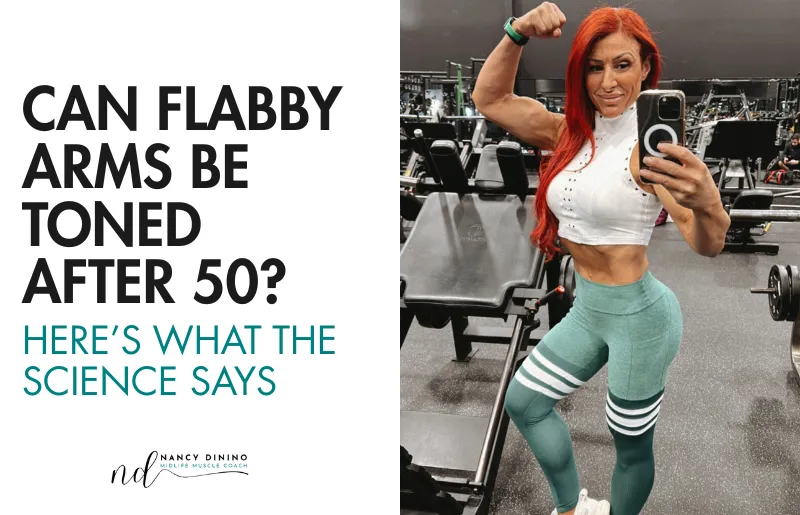
Can Flabby Arms Be Toned After 50? Here’s What the Science Says
Can Flabby Arms Be Toned After 50? Here’s What the Science Says.
If you're a woman over 50 who has been training since your twenties, eating clean, staying consistent, and still dealing with stubborn, soft upper arms, you're not alone. The truth is, your body has changed, but that doesn’t mean change is off the table. You can still build definition, tone, and strength, even in your 50s and beyond. You just need to work smarter with what your body actually needs now.
What Happens to Muscle as We Age
As women move through perimenopause and into menopause, hormonal changes, especially the drop in estrogen, cause a natural decline in lean muscle and increase in fat mass. This condition is known as sarcopenia, and it’s one of the biggest culprits behind the “flabby arm” look that seems to appear out of nowhere.
The good news? Research shows resistance training is highly effective in reversing this loss. One study by Isenmann et al. (2023) found that women who trained with weights experienced significant improvements in muscle mass and body composition compared to those who didn’t [1].
Why Strength Training Works After 50
The key to reversing age-related muscle loss is not endless cardio, but resistance training with progression. Chen et al. (2021) noted that resistance training improves both muscle strength and physical performance in older adults with sarcopenia [2]. This means more than just "toning." It means actively building and shaping lean muscle that enhances your strength, structure, and metabolism.
Forget light dumbbells and high reps with no real challenge. Women over 50 respond best to structured training with compound lifts, proper rest, and intentional progression.
Body Fat Distribution Changes Too
As estrogen levels decline, fat distribution shifts toward the midsection and upper arms. A study published in 2024 by Nunes et al. emphasized that higher-volume resistance training helped reduce body fat in older females while improving overall metabolic health [3]. This makes resistance training a two-for-one deal: better muscle tone and less fat accumulation.
Don’t Forget the Nutritional Piece
All the training in the world won’t do much if you’re under-eating protein or failing to fuel recovery. Muscle protein synthesis slows with age, which means your body needs more protein to trigger the same growth response you got in your 20s. Tan et al. (2023) suggest combining strength training with appropriate protein intake to maximize muscle building and fat loss [4].
So Can You Tone Flabby Arms After 50?
Absolutely. But you need the right inputs:
Progressive strength training
Consistent protein intake
Recovery time (stop overtraining)
A realistic plan that evolves with your stage of life
This isn't about spot reducing or chasing a quick fix. It's about building strong, sculpted muscle and managing body fat through smart training and smarter recovery.
You don’t need to be babied through a workout plan. You’ve got the discipline. You’ve got the years of experience. What you need is the strategy that actually works for your body now. That means ditching what you did in your 20s and 30s and adopting methods that respect the changes happening internally.
If you want a plan that matches your training age, experience level, and goals, submit an application to work with us here and let's see if we're a good fit!
Sources
[1] Isenmann, E., et al. "Resistance training alters body composition in middle-aged women." PMC, 2023. https://www.ncbi.nlm.nih.gov/pmc/articles/PMC10559623/
[2] Chen, N., et al. "Effects of resistance training in older adults with sarcopenia." PMC, 2021. https://www.ncbi.nlm.nih.gov/pmc/articles/PMC8588688/
[3] Nunes, P.R.P., et al. "Effect of resistance training volume on body adiposity in older females." Journal of Sport and Health Science, 2024. https://www.sciencedirect.com/science/article/pii/S2095254623000972
[4] Tan, T., et al. "Exercise improves muscle mass and strength in menopausal women." PMC, 2023. https://www.ncbi.nlm.nih.gov/pmc/articles/PMC10647115/
[5] Fragala, M.S., et al. "Resistance training for older adults: Position statement." Journal of Strength and Conditioning Research, 2019. https://journals.lww.com/nsca-jscr/fulltext/2019/08000/resistance_training_for_older_adults__position.1.aspx