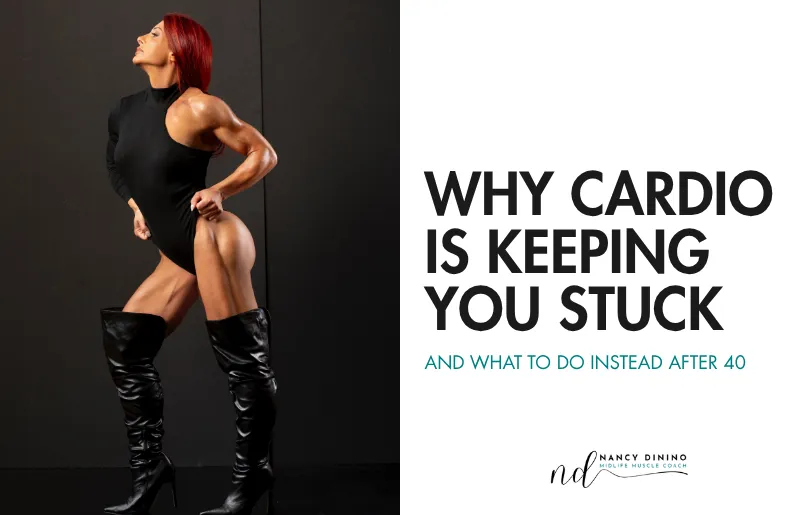
Why Cardio Is Keeping You Stuck (And What to Do Instead After 40)
If you're a woman over 40 who's been logging hours on the treadmill, spinning away in cardio classes, and still not seeing the body you're working so hard for, this is your sign to stop and read this carefully.
The Cardio Trap
We grew up believing that more cardio equals more fat burned. And in our 20s and 30s, that formula may have worked. But after 40, the rules change, and nobody tells us.
Here's what's actually happening inside your body: prolonged aerobic exercise, especially at higher intensities, significantly elevates cortisol concentrations compared to similar durations of resistance exercise. Elevated cortisol is highly indicative of muscle catabolism, meaning it actively increases the loss of lean muscle tissue.
In plain terms? Too much cardio raises your stress hormone, and that stress hormone eats your muscle for breakfast.
Why This Hits Harder After 40
Long hours of aerobic exercise can cause the body to increase cortisol levels, the major stress hormone that impacts everything from sleep to muscle gain.
Elevated cortisol can trigger weight gain, particularly in the abdominal area, counteracting the very benefits women hope to achieve through cardio.
This belly fat is the dangerous kind, visceral fat, which is linked with higher amounts of inflammation and actually sends signals to your body to increase hunger levels and decrease how satisfied you feel after eating.
So the more you do, the hungrier you get, the more belly fat you store, and the less muscle you hold onto. It's a cycle that cardio alone simply cannot fix.
What the Research Says About Strength Training
This is where it gets exciting. For women between 40-60, resistance training is one of the best ways to counteract age and menopause-related loss of muscle mass and strength.
A meta-analysis published in Aging Clinical and Experimental Research reviewed data from 745 postmenopausal women across 26 studies and found that small to moderate “significant increases in lean body mass were observed in postmenopausal and elderly women, regardless of age”, intervention period, or weekly training frequency.
And a groundbreaking study from the University of Exeter found that resistance training increases hip strength, dynamic balance, flexibility, and lean body mass in women aged between 40 and 60, with some measures of balance increasing to a greater degree in post-menopausal women.
What You Should Do Instead
This does not mean you have to give up cardio entirely. Daily walking as your primary form of cardio appears to be the best option, as lower intensity movement does not send the same cortisol-spiking signal that higher intensity prolonged cardio does. Shorter, high-intensity interval sessions of around 25 minutes can also provide significant benefits without the hormonal downsides of prolonged cardio.
The real shift is making strength training the foundation of your routine, not the afterthought.
Muscle is your metabolism. Muscle is your medicine. And the research backs it up: muscle burns more calories than fat, so whenever muscle is not preserved through weight training, the body simply does not burn as many calories.
You Don't Need To Work Harder
You need to work smarter, with a plan built specifically for your body right now, not the body you had at 30.
And that is exactly what I help women do inside my coaching program. In honor of turning 54 this week, I'm gifting new members up to 4 months of coaching, on me. Because no woman over 40 should keep spinning her wheels on a plan that was never designed for her.
Apply to work with me here and claim your birthday gift.
Sources:
Journal of Exercise and Nutrition: https://www.journalofexerciseandnutrition.com/index.php/JEN/article/view/108
BMC Women's Health (Resistance Training in Middle-Aged Women): https://bmcwomenshealth.biomedcentral.com/articles/10.1186/s12905-023-02671-y
Aging Clinical and Experimental Research Meta-Analysis: https://pmc.ncbi.nlm.nih.gov/articles/PMC8595144/
University of Exeter/Medicine & Science in Sports & Exercise: https://news.exeter.ac.uk/faculty-of-health-and-life-sciences/first-of-its-kind-study-shows-resistance-training-can-improve-physical-function-during-menopause/
PMC/Exercise Beyond Menopause: https://pmc.ncbi.nlm.nih.gov/articles/PMC3296386/
Nicole Rowe MD/Cardio and Menopause: https://nicolerowe.org/why-too-much-cardio-can-backfire-in-menopause